
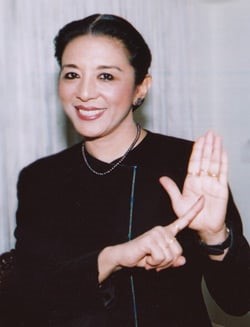
Sarah Giri
Friday, 19 December 2008 18:27
Well, let’s take a few minutes off and look hard at just one living, feeling, mobile, creative, and communicating ‘minority’ in our midst. It’s actually quite a sizable one.
I’m looking at our Deaf Community. We have schools for the Deaf right around the globe. The students there will soon emerge from the cloisters of academics and step into mainstream society as done by thousands of other deaf adults. I have as friends and acquaintances, web designers, software developers, chartered accountants, artists, bakers, college students, and restaurant stewards who are Deaf. Do you.
That’s exactly the issue, the challenge. What do the non-deaf Majority actually know of this Deaf Minority. I’m amused to say that for most of the non-deaf, the Deaf are disabled individuals with a pathological deficiency. The Deaf are those who do not hear. Sara Giri. Sarah giri.
Well, the view is not entirely untrue. Yes, the deaf do not hear. Imagine, though, you have a friend who is a music maestro. But you, well, you have neither the voice nor the ear for music. And so, every time your name is mentioned to your friend, the only view your friend has of you is that of a person who does not sing. How sound or complete is this line of thought.
I’m sure we’ve got the point. Yes, the deaf are those who do not hear. But is this all. Do the country’s hearing majority want to be ‘judged’ wanting in our knowledge of and interactions with our ‘Deaf Minority.’ For instance, how many from the non-deaf majority are aware that millions of Deaf around the world share an emotionally and intellectually enriching Deaf Culture.
Yes, Deaf Culture. All other what we call ‘Disability Groups’ do not have a defined Culture. But the Deaf do and the reason for this is quite obvious. The Deaf form a distinct LINGUISTIC group. We speak a common language (with possible regional variations) and as we know, language has always played a critical role in the birth and growth of a culture.
However, language is only one important prerequisite. Literacy, literature, a set of learned behavior and social norms all have their part to play in acculturation. And the Deaf have, over the past more than a hundred years, developed all of these in a remarkable way. Shall we respectfully spend a few minutes on a brief and for some an introductory tour.
Let us begin with the Language of the Deaf. I refer to Sign Language. So what about this Language. Let me share with you my personal discovery and experience.
My first encounter with Sign Language was at Dr. Chandra Sekhar’s Institute of Speech & Hearing, on January 26th, 2002. After four weeks of regular weekly classes, I requested a respected Deaf teacher from the Institute to become my Sign Language tutor. After learning the basics, a yearning to live, breathe and think Sign Language took over.
I volunteered as a Public Relations Officer for the Institute of Speech and Hearing, raising funds for the then fledgling Sign Language Department. Later, for a Life Development Skills program run by this department, I wrote the script and directed an educational movie for deaf youth. Several deaf artists performed side by side with non-deaf volunteers. Antony Jayant, a friend and a seasoned cameraman with several television soap serials to his credit, volunteered to do the entire shooting and editing.
The movie was eventually shown on several occasions to hundreds of deaf adolescents from some of the schools for the deaf in Bangalore.
Most importantly, though, to my utter joy and satisfaction, signing took on a new dimension for me. Besides communicating almost daily with deaf friends, I began interpreting serious discourses during weekly meetings and also at yearly and quarterly conventions. Today I look back to more than 5000 hours of interpreting plus recently conducting some of my most enjoyable workshops for adult deaf. And what is my discovery.
“Shall we then judge a [society] by the majority, or by the minority? By the minority, surely
”
- Ralph Waldo Emerson
First, on the effectiveness of the Language, I experienced it to be a language fully capable of communicating some of the most profound human queries, thoughts, and feelings. The vocabulary of signs is rich and progressive like it is in any living language used by the non-deaf.
Second, I have learned to appreciate the depth and beauty of expression in Sign Language. Incidentally, I was a radio program designer/script writer and broadcaster for 5 years prior to my encounter with the Deaf. Early in life, my parents sent me for intensive voice and speech training classes. Thanks to them, I eventually developed a keen appreciation for the Vocal and Verbal components of what I now call non-deaf language.
Would I miss these two elements in the non-spoken Sign Language? Well, no. Let me explain. For persons who hear, the voice is a carrier of the Verbal component. For the deaf, I soon saw and experienced artistic hand-shapes and facial expressions take over as a powerful substitute for the voice or ‘vocal component’. And just as some from the hearing crowd are gifted with an expressive voice, some deaf also have a natural flair for signing that’s both innovative and descriptive.
What about the Verbal segment? As we know, in the world of the hearing, this ‘verbal’ part occupies what is actually said or the content, inclusive of the language used. Can we identify this in the field of deaf communication? Yes. In my interactions, I noticed that the ‘content’ communicated by a widely exposed and ‘literate’ deaf is often deeper and broader. Even the repertoire of signed words, terms, and expressions boasts of a richer diversity.
You might be wondering what I mean by Deaf Literacy. Because in the society of the hearing, a ‘literate’ person is defined as one who can READ and WRITE a language that one speaks and comprehends. Is this true in the world of Deaf Communication?
Absolutely. For instance, in our schools for the Deaf, Sign Language includes signing all our alphabets and spelling words. A literate deaf learns to be a skilled READER of words and alphabets that are signed. A literate deaf also becomes adept at finger SPELLING or simply spelling with one’s fingers. But how does one WRITE Sign Language?
We know that the language of the hearing can be written on visible surfaces, like paper, wood, stone, and electronic screens. By contrast, Sign Language is a ‘spatial’ language. It is written on a rectangular area or ‘space’. This space extends from around the belly button and ends just above the forehead. The width is from one shoulder to the other. The depth can be anywhere from elbow to a full arm’s length. In this spatial area, pictures, gestures, and words are ‘WRITTEN’. The eye of a deaf person is trained to read in a ‘flash’ and comprehend what has been ‘spelled-out’ or ‘signed’ on this space.
Well, are you taking a deep breath? This is just the beginning of the panorama. What about Deaf Literature? Well, there is a rich collection of Deaf Folk Tales, Short Stories, Jokes, and Poems. Their worth lies in effectively signing them with dramatic and descriptive signs. Converting or translating a deaf poem into spoken language without disturbing its very essence, its signed beauty would indeed be challenging if not impossible. But humans being what we are, some from the hearing crowd have tried to translate some of this wealth of deaf literature into spoken language. Prior to this, all Sign Language Literature was ‘signed down’ from generation to generation.
Interestingly, by ‘generation to generation’ I do not mean from parents to children. Most deaf children are born to non-deaf parents and many deaf parents have non-deaf children. Statistics further reveal that less than 7% of the immediate family members of a deaf person learn Sign Language.
So, outside of our natural families, we the deaf search out one another. We are drawn together, sharing a physiological condition and or perhaps a non-acceptance by the non-deaf. But most importantly, we have in common the beloved language we communicate in. This bonding begins early in schools and colleges and continues in clubs and spiritual gatherings attended by the deaf. Thus is born what we call a Society of the Deaf. In these societies were born the stories, jokes, poems, and folk tales that form deaf literature. In time, ‘signing’ these stories, poems, jokes, and narratives grew to be a highly respected skill in our Deaf Culture.
To understand this better, consider the world of the hearing. Are all hearing people gifted poets, writers, and humorists? Of course not. Similarly, in the world of the deaf, not all are naturally skilled story, poetry, or humor signers. But those who do have these skills are recognized and respected. And just as some hearing people go to great lengths to acquire and perfect some of those skills, some deaf also avail themselves of training to become distinguished signers of story, poem, and humor.
I have noticed that the natural signing style of the deaf is enriched by our sharp and focused observation of other humans. The observation of hearing people can be highly diluted by the sense of hearing. I call it ‘vocal distraction’. But with the deaf, when we look, we look. We do not ‘hear and look’. Therefore, the deaf can see details that may elude the eye of a hearing person.
No wonder, the deaf emerge as great ‘Mime Artists’ anytime, anywhere. Occasionally, in a moment of humor, I have caught my deaf friends ‘mime’ me. Well, I see my funny side and laugh at myself. At other times, when we have a ‘mime’ session, it’s like watching a spontaneously enacted ‘drama’ or a ‘comedy’. This absolutely delightful experience has been possible for me only among my deaf friends.
What about some social ways among the deaf? Let’s have a quick look.
There’s a dinner party on. You want to make an announcement. You want the attention of all present. In a gathering of the hearing, you may do any number of things from assertively calling out: ‘Ladies & gentlemen!’ to ringing a bell, clapping your hands, or tapping a glass with a spoon. But if it’s a deaf gathering, we do other things. It could be turning the lights off and on a couple of times or stomping on the wooden floor with your foot. You may even decide to stand center stage and raise both your arms.
In an evening social gathering among the hearing, soft lights are preferred by many. But among the deaf, bright lights are in as they promote interactive signing.
In the world of the hearing, it is considered poor manners to talk with one’s mouth full. Among the deaf, it is perfectly fine to sign with your mouth full. But definitely undesirable to sign with one’s hands full. So if I want to communicate in signs and I happen to be holding something, I should ideally put it down, free my hands completely, and then sign.
Finally, let’s come to naming people. I find this interesting, sometimes amusing, and definitely innovative. In the hearing community, one has a name that is voiced or spoken. But in the deaf community, one has a name that is signed. We call this one’s ‘sign name’ and it is mostly created by oneself, one’s teacher, or even friends. The sign is by and large ‘iconic’ in that it may dramatize some unique feature of the person being named. For instance, my sign name is a signed ‘S’ placed at the outer edge of my right eye. This is to emphasize my slant Tibeto-Burman eyes. It was given to me by deaf friends in south India where slant eyes are rather uncommon.
Well, we could go on and on. But we won’t. Instead, let’s take a step back and admire the brave and successful strides our dear Deaf friends have made in adjusting to living in a predominantly Hearing community. How about some initiative from members of the Hearing majority.
No, we are not talking about charity. We are talking about the initiative to acknowledge, communicate with, understand, appreciate, and include the Deaf into mainstream society. Something well accepted is the need for responsible members of society to reach out and get to know people of different cultures sharing our planet earth. Some go to great lengths to learn French, Spanish, German, and Japanese languages and their respective cultures. We hear of widening our horizons of social inclusion and narrowing down borders of prejudice.
Well, what about learning of the Deaf right in our midst. The Deaf are a people with a distinctive culture. We have done admirably in surviving and thriving as a minority in a society with a hearing majority.
I invite all the deaf to educate ourselves about our rich heritage and culture. I encourage my deaf friends to go out and educate and enlighten the hearing about our Deaf Life and Culture. I advise our hearing friends to step out of the confines of the social barrier of being a hearing person. Yes, reach out for the cultural richness of the Deaf and begin this journey that will change your life forever. Through personal experience, I found this enriching journey begins with learning the language.
However, if we decide to go home and sit back, will we not be communicating that higher education, corporate jobs and the comfort of family communication are the luxury and prerogatives reserved only for the hearing majority?
Well, let bygones be bygones. We can and must make a fresh start. How about assigning this year 2009 to be a starting point for this positive change in the way we view and interact with our Deaf minority? Let us work towards making our respective cities, offices, schools and colleges into happy hubs of proud Signers!
For after all shall we judge a [society] by its majority or by its minority? By its minority, surely.